

On the Bowery
(Period from Nov. 1948, return to NYC, -enter my father’s business until quitting in fall of 1954).1
The end of an experiment. I decided to join Beaunit Mills Inc. my father’s corporation for several reasons, which originated on the bridge of my ship AMC 94 (Auxiliary Mine Sweeper) during a hurricane in Charleston harbor in 1945. Standing there in the calm between storms I meditated about my existence and the state of the universe.
I knew that I would soon leave the Navy and I felt I needed to formulate a plan for my future life. WWII had left me shaken and disturbed, I was aware of the holocaust and the horror of nuclear weapons that had been dropped at Hiroshima and Nagasaki and I was not overjoyed by those events although we were told that nuclear weapons had ended the war with Japan. I was skeptical about that reasoning and after some examination I don’t believe it was necessary. My reasoning then was that after such disasters going back to a normal existence was absurd. If everyone did not dedicate his life to profound changes in society and the cause of peace at least I would do so.
I wasn’t sure how to proceed with this vision but I decided to be practical which meant to eventually join my father’s business in order to have a financial base from which to function. I also believed it would be useful to obtain experience in the world of business and finance before entering the realm of international relations, but for a limited time of ten years. That period was eventually telescoped to six, from 1948 until 1954 but first I decided to return to Yale and Chemical Engineering because I had the principle that you should complete a course of action once started although I found engineering decidedly distasteful and in the long run not ideal for my future. What made it worthwhile was that I decided to extend the time of my return to Yale for two years and take courses in the humanities, history, psychology, religion, literature and political science, subjects more useful and interesting for my future.
In 1948 I went into my father’s business but eventually left for a complex of reasons primarily because I had different interests, however I was also propelled because of my father’s volatile and explosive nature which I believe would have exhausted me. When I finally decided to make the break in the spring of 1954 I realized I would have to find a new career, I then considered three options. A position in the UN, a journalist or writer, or film director. I chose film making, because I sensed that I didn’t have the patience and personality for politics nor the experience for writing but I felt that I had some affinity for cinema.
Therefore at the end of 1954 I started to search for a subject. Since 1948 I had been concerned by the rise of Apartheid in South Africa and the election of the Nationalist Government. It seemed to me like a new form of fascism and I knew that some day I would go to South Africa to make a film exposing the evils of that system. In the meantime I had to learn how to make a film. The subject I finally chose was the homeless men of the Bowery because it was dramatic and powerful. Living on 11th St. in Greenwich Village I was sometimes stunned by the faces of the homeless men that I found sprawled on my doorway in the morning. I asked my self where they came from. (poem by E.E. Cummings). I intended to make a short film in order to learn the principles of film making, not having the slightest idea of how to begin. I was advised to attach myself to a film production and I joined Roger Tilton in his production of Square Dance. It was a quick production of a few days but gave me some idea of the essentials of film making, which seemed to me simply to record events as they happened, although I didn’t know how to proceed I did know what I wanted.
My aim was to create a fusion of two film genres, Robert Flaherty’s poetic realism particularly in Man of Aran and the neo-realism of De Sica in Bicycle Thieves. I had been enthralled by both of these films. I saw Man of Aran at my local cinema in Port Washington around the age of twelve, and for some peculiar reason it was like a thunderbolt of inspiration. Many years later in the post-war period there was a tidal wave of Italian neo-realistic cinema of De Sica and Rossellini. This was a new kind of cinema compared to vintage Hollywood, direct, strong and simple expressing the conditions of the time in post war Italy. These two forms of cinema had many things in common, particularly the use of real people as performers rather than professional actors. This was an attempt to get away from the star system to a more mature and freer method, I believed then that it would be the wave of the future. I was wrong.
What I wanted to do was to find a way between the poetic realism of Flaherty and the narrative form of De Sica to a semi-fictional style solidly grounded in authentic realism.
I began, using Flaherty as a guide by exploring the Bowery and all of its aspects, the streets, bars, flophouses, and missions. This went on for many weeks, night and day, but I didn’t then have an idea of how to proceed, however Roslyn Kossoff an independent film distributor, indicated the way. She said that since I was so inspired by Flaherty I should work the way he did spending years observing his subject and the form and substance would then grow out of that. I knew immediately that was the solution for me. I rejected all other more abstract forms and styles; Flaherty was the filmmaker I wanted to emulate.
For months I just observed the life on the Bowery, at all hours of the night and day and I developed some absurd schemes. At one point I decided I had to photograph men in the bars secretly. I had a box made for my Bolex camera with a hole in it for the lens. Naturally the results were pathetic and I gave that method up. It was then that I abandoned all pretense of secrecy and decided to come out in the open. Eventually I found out that if I told the people what I wanted to do they were very cooperative and ever since that has always been my method if possible.
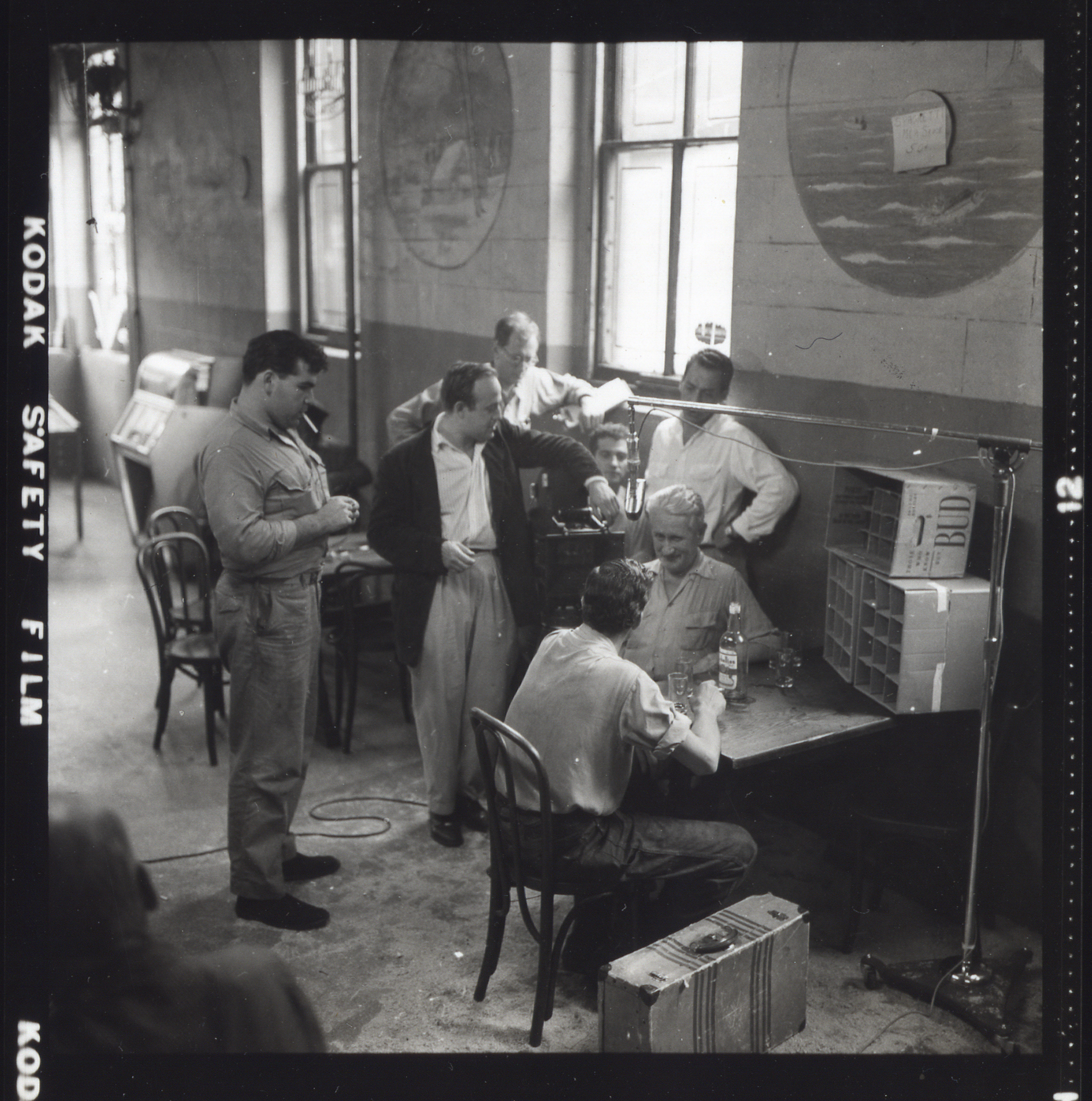
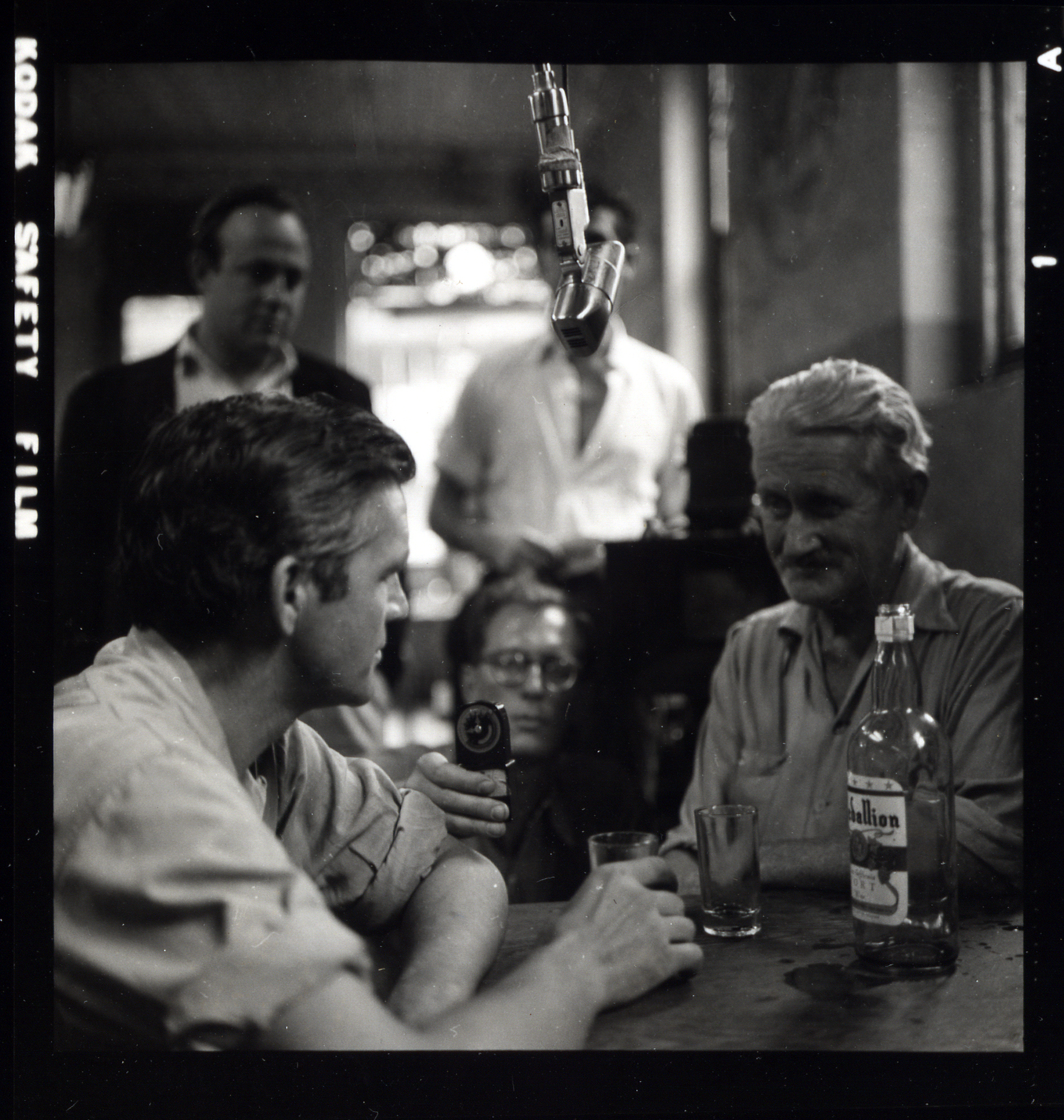
In my wanderings I met Gorman Hendricks who became my guide for many months. Slowly I began to gather a crew in a rather unorthodox way. I met most of them in the White Horse Tavern on Hudson St. in Greenwich Village, across the street from Perry St. where I lived. My first recruit was Mark Sufrin a highly intelligent, freelance writer, aggressive and volatile, full of ingenious ideas. When I started thinking about a cameraman Sufrin suggested Dick Bagley who was considered a Village genius, I rejected that idea at first because I had seen and heard Dick in the White Horse. He was as raucous as a wounded crow and I was unimpressed but I later decided to see his work and after a screening I decided that his eye was superior to his oratory. He then came to my flat where I showed him film I had taken myself. I could tell that the material grabbed him and he said what do you want to do. The walls of my room were covered with Rembrandt portraits, I pointed to them and replied, “THAT”. He immediately knew what I meant. I suspected that his affinity for the subject was connected to his alcoholism. He immediately said this material is too good for a short film. You have to make a feature. Before I answered I had agreed because I had been thinking the same thing for weeks. I feigned doubts because of the cost and risk but I quickly agreed with him and we were off. I remarked that the biggest risk you took was being born, after that it was downhill.
He was wilder then any of the Bowery cast. After the first few days of shooting, the chief protagonist Ray Salyer said, “this guy drinks more than I do.” I was appalled after the first day’s shooting at his alcohol consumption and thought, my God I’ve got an alcoholic on my hands. I held my breath and waited for the first day’s rushes. They were perfect so from then on I never looked back. During the shooting I discovered that Bagley and I had a visual rapport that was uncanny. We rarely discussed the photography; I just indicated the subject and it always turned out as I imagined it. During the day Bagley rationed his Gin and Tonics and when we came together every evening he let down the floodgates until 3 AM. The next day he would greet the sun like a half drowned Robin, so sick I thought he might die but after an hour or two he was ready to go again. We both had a passion for the film and it turned out to be an artistic love affair. He became so intense about the project that he responded as if it was his film. This was to cause us some difficulty during the editing.
Dick was my unofficial authority on Italian neo-realism, since he had spent several years in Rome sitting and drinking on the Via Veneto absorbing the Italian style of filmmaking. One thing we agreed upon was absolute authenticity and spontaneity. In the beginning Dick insisted that we did not need a script and that the story would flow out of the life on the Bowery. This suited my preconception, but after the first day’s shooting Dick startled us by announcing that it was unsatisfactory because we needed some kind of outline to follow. Dick, Mark and I then sat down and that Saturday proceeded to hammer out a story line of a few pages.
We had our framework of street scenes but our outline didn’t include dialogue. Our intention was to improvise which I didn’t know how to do but I discovered the way on the set when I realized that Gorman, Ray, and Frank had many personal stories and anecdotes, which they could easily recall. I began to realize that as long as I stuck to the incidents of their lives the dialogue would remain believable and spontaneous. I had developed a method of improvised dialogue, which I used in my future films.
One day I noticed that Gorman had suddenly become severely bloated. I then took him to the doctor who discovered that he had developed cirrhosis of the liver and told me that anymore drinking of alcohol would be fatal. I felt that, as a confirmed alcoholic Gorman wouldn’t have the determination to stop. A few days later we had dinner together and Gorman told me not to worry because he would not let me down and that he would stop drinking. I was both touched and amazed at his dedication to our project. I now felt that motivation could be a powerful deterrent to overcoming alcoholism. From previous information and experience I thought it was nearly impossible for someone to voluntarily stop drinking. Gorman stopped drinking until the completion of the film and then sadly began again. He no longer had anything to live for. A few days after the completion of the film I received a call from the police informing me that Gorman had been found dead in a bar on the Bowery with my card in his pocket. I was shaken by the news. We had formed a close bond of affection and friendship.
We started filming in July of ’55 and completed photography in Oct. and thence on to the editing which was fraught with problems. Not having made a film before I was a little in the dark and floundered around under the tutelage of Bagley who wasn’t logical or rational, he was perceptive, highly intuitive and sensitive. His artistic reactions and sense of imagery were brilliant but his editing decisions were illogical and I frequently ignored them. During the shooting he made a bizarre suggestion that we shoot the scenes without dialogue on 16mm. and the sound and dialogue scenes on 35mm, an editor’s nightmare to integrate. I sensed this disaster but accepted Dick’s seniority with the argument that 16mm was cheaper, but in the long run editing time was more costly. An even more unfortunate decision was selecting Helen Levitt as the editor. The problem was that she wasn’t a qualified editor. I knew her as part of the team that made The Quiet One, James Agee, Sidney Meyer, Janet Loeb, and the inimitable Bagley. Personally I didn’t find any rapport with Helen, she was austere and taciturn and never spoke to me regarding any of the scenes. I complained to Dick about this and he said wait until the end of the editing and we’ll talk. I thought this was a bad idea as I watched Helen chop out meaningful passages because of her ignorance of the material. An editor who is ignorant of the intrinsic meaning of the photographic material will lose the essence of it in the editing. Nobody new this better than I despite my inexperience.
We then had the first screening of a rough cut – a hilarious disaster. The audience left the screening room in a state of bewilderment. I knew that my worst suspicions were correct. Helen had cut the heart out of the film. When I spoke to Dick that night, he was very imperious and talked as if it was his film. He said we have a lot of work to do, implying that he would supervise the editing. I felt threatened by his attitude and decided that I had to remove Dick and Helen from the cutting room. I arrived early next morning and locked them out. Surprisingly there was very little uproar although Dick must have been disturbed. We had lived this production night and day for four months and it had become an artistic love affair, he was my closest friend during this period but I realized he was ruining the film and wouldn't collaborate. His primary collaboration as cameraman was over.
I didn’t consider editing the film myself, I wasn’t technically equipped to do it; therefore I looked around to find a top notch editor regardless of the expense since I had had enough anguish already. I then contacted Carl Lerner who I had previously met. I found him professionally impressive and convivial, and after an initial hitch we had a marvelous collaboration. Our first difficulty was after he had screened all of the material; he said I’m not sure that we can save this project. I thought he was absurd and I was intensely annoyed with his lack of faith, I was so convinced of the power of the material that I was sure that On the Bowery was destined to become a great film. I think Bagley shared my enthusiasm. At that time I felt that it was interesting that others could not see the potential of the material that a creative artist senses.
During the early days of the editing we discovered that the dialogue of the film was quite muddy which meant that the film was unsalvageable but we requested the lab to make reprints from the original and discovered that the quality was adequate. That caused me a moment of panic.
Finally we completed the editing. The whole process was agonizing and I was relieved that it was over. Carl and I were relatively satisfied with the results. I had decided to enter the film in the The Documentary Film Festival at Venice and on the way visit London at the invitation of Lindsey Anderson and Karel Reisz of the Free Cinema.
In the spring of 1956 I made a momentous decision and married Elinor Hart. I’m aware that it was a crucial decision but I have decided to leave it out of this narrative.
After an ebullient welcome in London from Lindsay and Karol I went on to Venice after a tour of Provence by car covering Van Gogh’s sojourn in Arles and St. Remey. Visiting Van Gogh’s haunts was redolent of his influence upon me, my film making, and my art. I remember being struck by the words in one of his letters, “You can expect to be scorned, condemned, and humiliated.” (THE PRICE FOR SEEKING THE TRUTH) I remember feeling a moment of exhilaration and terror at those words, wondering whether that was to be my fate. In Venice I met Basil Wright who became a fast friend and we amused ourselves with critical jokes about film distributors. The night of the awarding of the prizes Basil led me into the hall and whispered into my ear that I had won the Grand Prize. I didn’t focus on that fact right away but he pushed me into the hall in the midst of an ovation and it finally dawned upon me what was happening.
Soon after that I met John Grierson the Grand Dean of documentary film who told me that at the Edinburgh Film Festival the respectable elders of the festival had found On the Bowery distasteful. Grierson’s fateful and prophetic words to me were “You’ve made a great film, but don’t expect anyone to like you for it.” Grierson was reiterating the sentiment of Van Gogh, sometimes the artist has the premonition of doom, because he senses that the struggle for truth is antagonistic to the prejudices of society. I realized the perception of those words and they seemed to follow me around for the rest of my career. Right after that an incident occurred which confirmed the perception of Griersons comment. The US consulate gave a reception to the festival participants and as I went to greet our ambassador Claire Booth Luce she turned her back upon me and promptly left the room and flew straight back to Rome. On the Bowery profoundly offended the super patriots of the State Dept. I was certainly, scorned, and condemned by the US cultural establishment.
Luce’s offensive behavior is an example of what Mark Twain described as Bad Patriotism. (Quote Mark Twain’s essay on patriotism) Patriotism can be constructive when it is based upon rational loyalty to an individual's nation or group, but when it is excessive and destroys the bounds of morality and justice, and violates the rights of others; it is no longer patriotism but self-destructive narcissism. Frequently it is a convenient subterfuge for demagoguery. As Oscar Wilde said patriotism is the first refuge of the scoundrel. False patriotism has been a device to promote warfare and imperialism throughout history. What seems to the people to be patriotism when excessive (chauvinism) turns out to be unbalanced antagonism towards all opposition, which can erode the democratic structure of society?
Ellie and I left Venice and went back to London and then Paris in order to find distribution for On the Bowery. I spent several months at that thankless task and although the film had achieved great critical acclaim I was unable to obtain a reasonable financial offer. During my stay in London the film was given The British Academy Award for Documentary Film. Armed with these credentials I returned to NY where I obtained an opening at the 55th St. Playhouse.
Meeting with Rossellini
During my previous visit to Paris the Cinematheque Française made quite a fuss about On the Bowery and word got around to Rossellini about it and he summoned me to an audience with him. I visited him at his hotel and met him and his wife Ingrid Bergman, I found her quite beautiful, surprisingly more so than she was on the screen. We had a very curious meeting. Rossellini had a very interesting proposition. He wanted to form a group of international independent filmmakers to produce high quality films and to form an association for financing and distributing this film. An excellent and visionary idea. I was sympathetic to the idea but trapped by my future plans. By that time I had definitely decided to go to South Africa to make my anti-Apartheid film and I believed it crucial that I maintain the utmost secrecy, therefore I had to turn Rossellini down and I told him I was planning to go to India. He immediately blanched and quickly ended the discussion. It was unfortunate and I believe it was an important opportunity lost. Rossellini was a creative and broadminded man of cinema. He was particularly upset when I told him I was going to India, ironically he was also planning his next film in India although I wasn't, I simply used India as an excuse. He went to India to make his epic but was nearly deported by the temptation of a romantic involvement with an Indian actress. I've always regretted the fact that we didn't collaborate although we met again later on friendly terms. It is difficult for filmmakers to collaborate.
I finally returned to NY in the fall of 1956. It was an autumn fraught with upheaval. The Hungarian uprising and the Suez crises. For the NY opening of On the Bowery I obtained the services of a publicity agent, Phil Bloom. He did an admirable job of promoting On the Bowery. The NY press was very exercised about the interest of the Hollywood studios in Ray Salyer and we got a great deal of publicity about that. RKO expressed an interest in Salyer because although he was a Bowery man he did have some intrinsic star quality and was quite cinematic. When I asked him if he was interested in an acting career he seemed indifferent. By that time we had become friendly and spent time together, in the back of my mind I might have hoped he would give up total dependency on alcoholism. He quickly discouraged that optimism when he described his existence. He told me he would acquire several gallons of Gallo Muscatel wine which he would take to his flophouse room and consume and, after several days of isolation he would then replenish his stock. This routine left little initiative for a film career and when the Studios learned of his alcoholism they lost interest.
The film got excellent reviews from most of the press except Bosley Crowther who rather viciously attacked the film. I was surprised at his comments because he seemed to resent the European acclaim. We all met at Sardi’s for a post opening celebration and I remember being slightly demented by Crowthers review because I was aware that his review carried the field. I became quite irrational during the evening threatening a lawsuit against Crowther. I am aware that my protest was useless however he had destroyed my chances of commercial distribution. A few years later I became more objective and after my second bad review from him, I decided that I would outlive him, which I did, unfortunately that didn’t solve my problem.
- 1
Lionel Rogosin wrote this text as part of an unfinished biographical project. Its exact date is unknown, though we know he was working on it in London in 1997–1998.
Images published with courtesy of Michael Ariel Rogosin.

